Master Chemistry with Clear, Step-by-Step Explanations
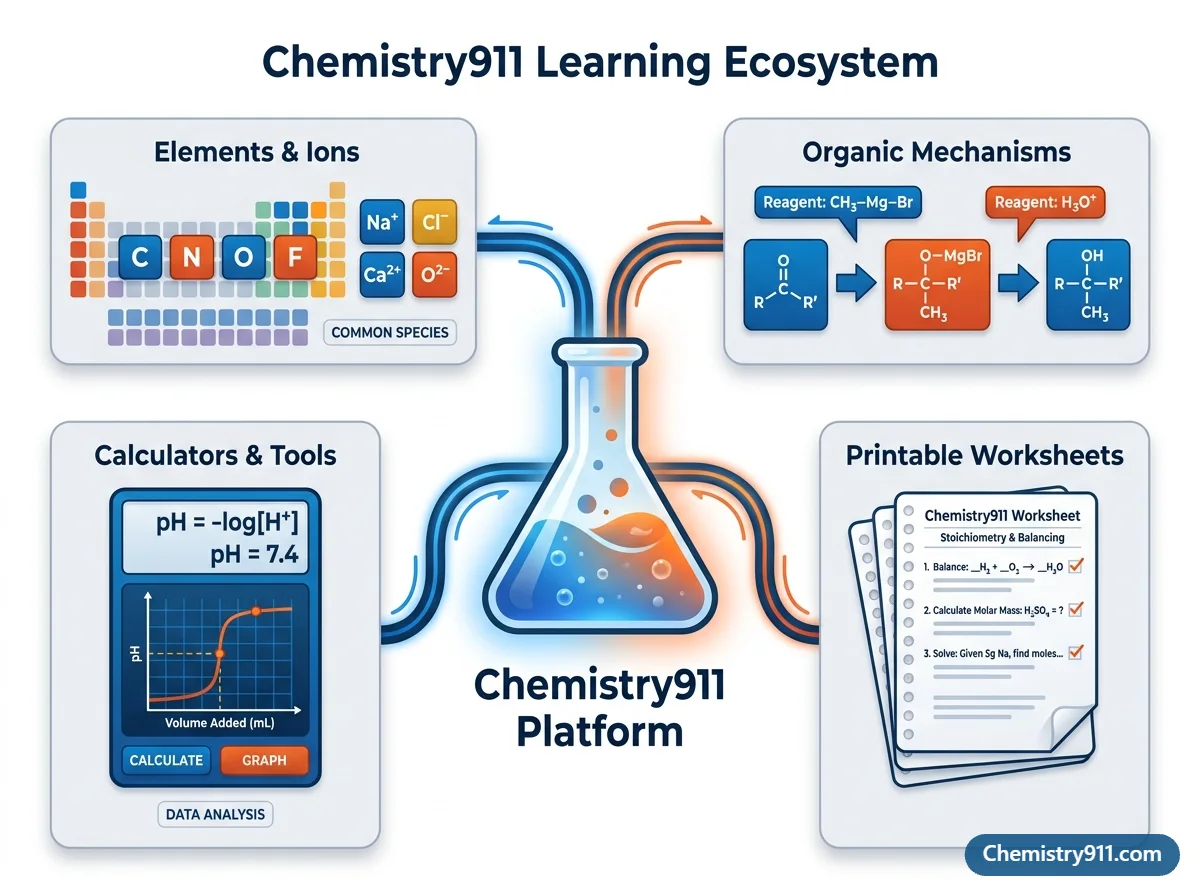
Whether you are tackling AP Chemistry, surviving organic chemistry mechanisms, or teaching a college lab, Chemistry911 provides over 1,000 free, expertly written guides. Explore detailed element profiles, reaction mechanisms, step-by-step Lewis structures, interactive calculators, and printable worksheets with answer keys.
Explore Chemistry by Branch
Chemical Elements
All 118 elements: properties, electron configurations, uses, and safety.
118 pages🧪Compounds & Ions
Formulas, structures, preparation, reactions, and uses of inorganic compounds and polyatomic ions.
101 pages🔬Organic Chemistry
Functional groups, named reactions, mechanisms, stereochemistry, and synthesis.
273 pages🌡️Physical Chemistry
Thermodynamics, kinetics, gas laws, equilibrium, atomic structure, and solutions.
153 pages💎Inorganic Chemistry
Coordination chemistry, VSEPR, crystal-field theory, and bonding models.
13 pages📊Analytical Chemistry
Titration, chromatography, spectroscopy, and electrochemical analysis.
17 pages☢️Nuclear Chemistry
Radioactive isotopes, decay modes, half-life, fission, and fusion.
14 pages🔩Materials Chemistry
Alloys, polymers, and the chemistry behind engineered materials.
26 pages🔗Lewis Structures
Step-by-step Lewis structures with geometry, polarity, hybridization, and formal charge.
83 pages🧮Chemistry Calculators
Molar mass, molarity, dilution, pH, ideal gas, stoichiometry, and more — with worked steps.
12 pages📝Worksheets
Free printable chemistry worksheets with answer keys for high school and AP.
108 pagesFeatured Lessons
Stephen Reaction
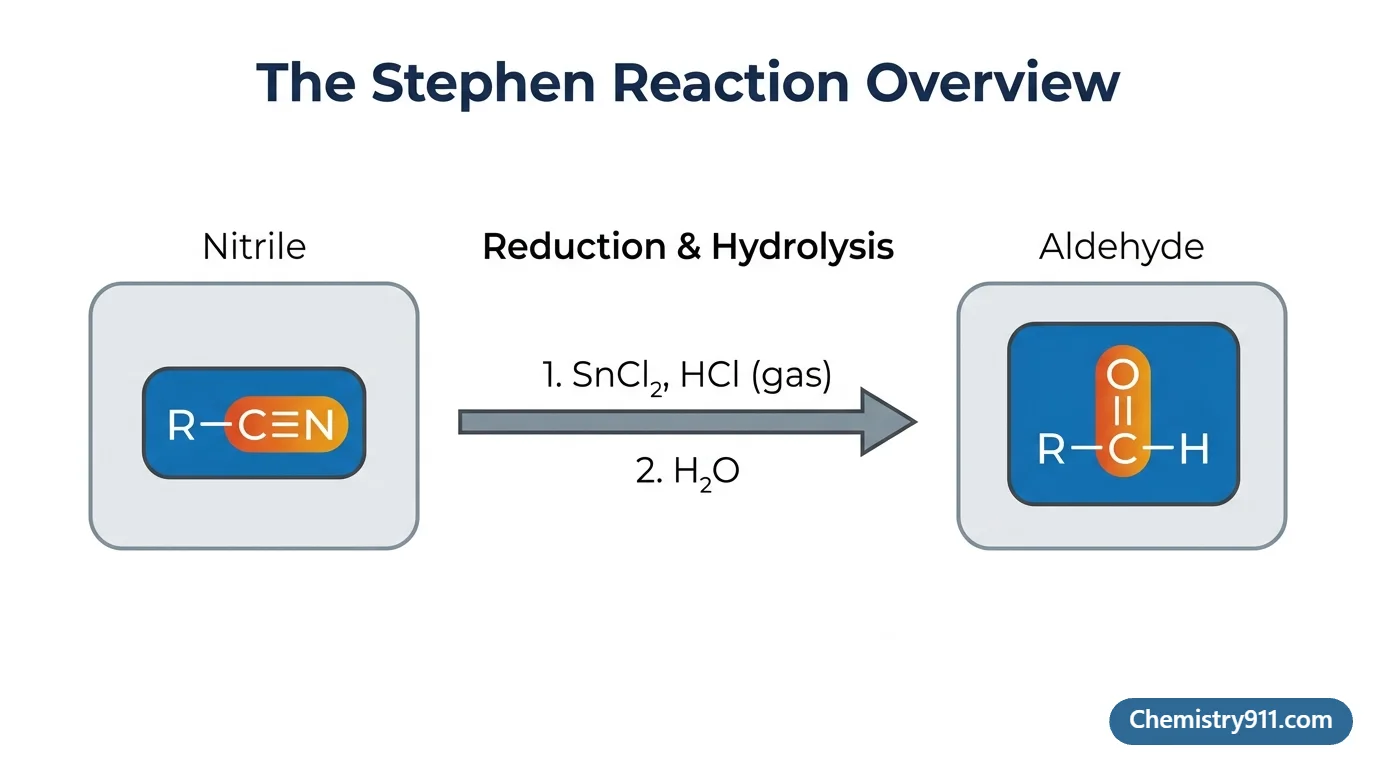
The Stephen reaction reduces nitriles to aldehydes using tin(II) chloride, HCl gas, and water. Learn the step-by-step mechanism, conditions, and examples.
Bond Angles
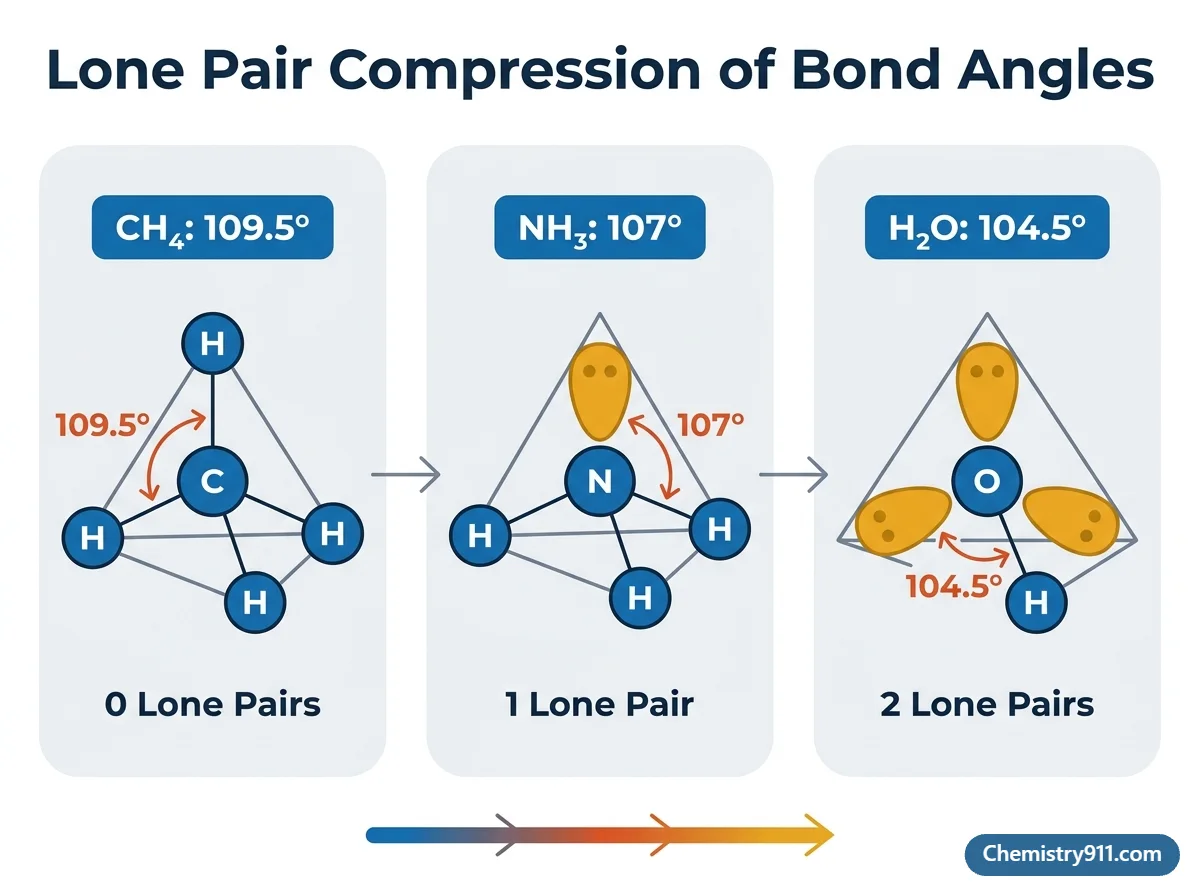
Bond angles determine molecular shape and polarity. Learn how to calculate bond angles using VSEPR theory, memorize ideal angles, and predict deviations.

Hiyama Coupling
The Hiyama coupling is a palladium-catalyzed cross-coupling reaction between organosilanes and organic halides to form carbon-carbon bonds.

Acetylation Reaction
Acetylation introduces an acetyl group into a molecule to form esters or amides. Learn the nucleophilic acyl substitution mechanism, reagents, and…

Permanganate Ion (MnO4-)
The permanganate ion (MnO4-) is a powerful oxidizing agent recognized by its deep purple color. Learn its structure, pH-dependent redox reactions, and…

Pinacol Coupling Reaction
The pinacol coupling is a reductive dimerization of aldehydes or ketones to form a 1,2-diol. Learn the radical mechanism, reagents, and stereochemistry.
Why Chemistry911?
Accurate, Reviewed Explanations
Every guide is rigorously checked against IUPAC and NIST standards to ensure chemical accuracy.
Visual Learning Tools
Complex mechanisms and molecular structures are broken down with clear, custom-designed infographics and diagrams.
Calculators and Worksheets
Speed up your homework with interactive chemistry calculators and download printable practice worksheets with full answer keys.
Built for Real Studying
Skip the fluff. We provide quick answers, worked examples, and step-by-step problem solving designed for how students actually learn.
How to Use Chemistry911 for Your Course
Chemistry is cumulative, meaning a strong foundation is essential. We have organized Chemistry911 to support you from your first high-school class through advanced college courses.
- High School and AP Chemistry: Start with our core physical and inorganic chemistry modules. Master stoichiometry, gas laws, and atomic structure. Use our step-by-step Lewis structure guides for molecules like SO42− or H2O to build your intuition for bonding.
- Organic Chemistry: First-year organic students can navigate directly to our functional group and named reaction databases. We break down complex mechanisms—like the Grignard reaction where CH3MgBr reacts with a carbonyl—into clear, numbered steps showing precise electron flow.
- Advanced and Analytical Chemistry: College students will find detailed resources on thermodynamics, nuclear decay pathways, and analytical techniques.
- Educators: Browse our library of printable worksheets. Each topic includes practice problems and a corresponding answer key to streamline your lesson planning.
Use the search bar to find specific compounds, ions, or concepts, or browse by major chemistry branches using the main navigation menu.
What Makes a Great Chemistry Explanation
Many chemistry resources fail because they either oversimplify the science or bury the reader in dense, textbook-level jargon. At Chemistry911, we bridge that gap by focusing on clarity, visual learning, and practical application.
A great chemistry explanation must be immediately actionable. When you look up a reaction mechanism, you do not just need the final product; you need to see the intermediate states, the transition states, and the formal charge changes. We use a standardized format for all complex topics:
- The Core Concept. A concise definition of the reaction, law, or property.
- The Visual Breakdown. High-quality diagrams illustrating molecular geometry, electron pushing, or phase changes.
- Worked Examples. Step-by-step math or logic.
When calculating the pH of a weak acid, we first define the equilibrium expression using Ka, set up an ICE (Initial, Change, Equilibrium) table, and walk through the algebraic solution before applying the formula pH = −log[H+].
By standardizing how information is presented, you spend less time deciphering the page layout and more time mastering the actual chemistry.
Our Editorial Standards and Accuracy
Chemistry911 is built by a dedicated team of chemistry educators, researchers, and science communicators. We know that a single misplaced decimal point or a missing negative sign on an ion like NO3− can derail hours of studying. That is why our editorial process prioritizes strict scientific accuracy.
Every article, calculator, and worksheet undergoes a rigorous review process:
- Authoritative Data: All numeric values, including atomic masses, electronegativities, and thermodynamic constants, are sourced directly from the National Institute of Standards and Technology (NIST) or the PubChem database.
- Nomenclature: We strictly adhere to the International Union of Pure and Applied Chemistry (IUPAC) guidelines for naming organic and inorganic compounds, ensuring you learn the universally accepted terminology.
- Continuous Updates: Science education evolves, and so do we. We regularly update our guides based on user feedback, new pedagogical research, and updates to the AP Chemistry and standard college curricula.
Our mission is to democratize science education by providing premium, textbook-quality chemistry resources entirely for free, without paywalls or restrictive registrations.
Frequently Asked Questions
Is Chemistry911 completely free to use?
Yes, all of our guides, interactive calculators, and printable worksheets are 100% free. We do not require subscriptions or hide content behind paywalls.
Who writes the content on Chemistry911?
Our content is written and reviewed by a team of experienced chemistry teachers, professors, and subject matter experts. We ensure every guide meets high academic standards.
How do you ensure the chemical formulas and data are accurate?
We cross-reference all numerical data, formulas, and constants with authoritative databases like NIST and PubChem. We also strictly follow IUPAC nomenclature rules for all compounds.
Can teachers use your worksheets in their classrooms?
Absolutely. Teachers and educators are encouraged to download, print, and distribute our worksheets and answer keys for classroom use, homework assignments, or lab prep.
How should I cite Chemistry911 in my research or lab report?
You can cite us as a standard website reference. Include the specific page title, 'Chemistry911', the URL, and the date you accessed the information.
How do you choose which chemistry topics to cover?
We base our content on standard high school, AP, and undergraduate chemistry curricula. We also prioritize topics based on student search trends and direct requests from our community.