Stephen Reaction
The Stephen reaction is an organic reduction process that converts a nitrile into an aldehyde. It uses anhydrous tin(II) chloride (SnCl2) and hydrogen chloride (HCl) gas to form an intermediate iminium salt, which is subsequently hydrolyzed with water to produce the final aldehyde.
- Reaction TypeReduction
- Starting MaterialNitrile (R–CN)
- ProductAldehyde (R–CHO)
- Key ReagentsSnCl2, HCl (gas), H2O
- IntermediateIminium hexachlorostannate salt
- Discovered ByHenry Stephen (1925)
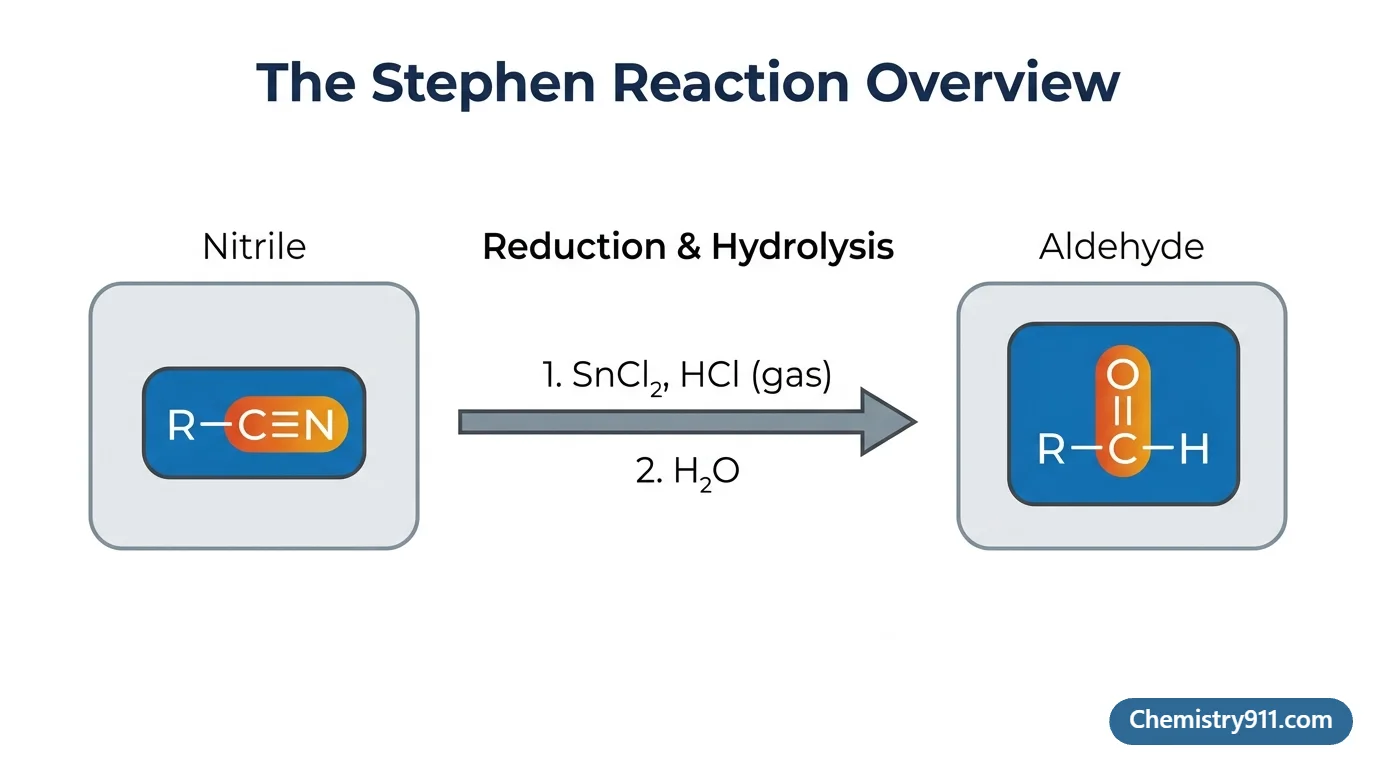
Synthesizing aldehydes without over-reducing them to alcohols is a classic challenge in organic chemistry. The Stephen reaction provides a targeted solution, allowing chemists to convert nitriles directly into aldehydes. By employing tin(II) chloride and hydrogen chloride gas, this method traps the reduction at the imine oxidation state. Subsequent hydrolysis yields the desired aldehyde, making it a valuable tool, particularly for the synthesis of aromatic aldehydes.
What Is the Stephen Reaction?
The Stephen reaction, also known as the Stephen reduction, is a classic organic chemical reaction used to synthesize aldehydes from nitriles. Discovered by the English chemist Henry Stephen in 1925, this method provides a reliable pathway to halt the reduction of a carbon-nitrogen triple bond at the intermediate imine stage, preventing complete reduction to an amine or an alcohol.
The overall transformation involves treating a nitrile with anhydrous tin(II) chloride (SnCl2) in the presence of dry hydrogen chloride (HCl) gas. This forms a crystalline intermediate salt. Upon the addition of water, this salt undergoes hydrolysis to yield the corresponding aldehyde.
R–C≡N + SnCl2 + 3 HCl → [R–CH=NH2]+ [Cl]− + SnCl4
followed by
[R–CH=NH2]+ [Cl]− + H2O → R–CHO + NH4Cl
In practice, the tin species forms a complex hexachlorostannate(IV) anion, making the actual intermediate a dimeric salt: [R–CH=NH2]2[SnCl6]. The ability to isolate or trap this intermediate is what makes the Stephen reaction so effective at preventing over-reduction.
Reagents and Reaction Conditions
The success of the Stephen reaction relies heavily on the precise control of reagents and the reaction environment. The process is highly sensitive to moisture during its initial stages, requiring strictly anhydrous conditions until the final hydrolysis step.
- Tin(II) Chloride (SnCl2): This acts as the reducing agent. It must be anhydrous. Tin(II) is oxidized to tin(IV) during the reaction, providing the two electrons necessary to reduce the carbon-nitrogen triple bond.
- Hydrogen Chloride (HCl) Gas: Aqueous hydrochloric acid cannot be used because water would prematurely hydrolyze the nitrile to an amide or interfere with the reduction. Dry HCl gas is typically bubbled through the reaction mixture to protonate the nitrile and facilitate the formation of the stannate complex.
- Solvent: The reaction is usually carried out in an inert, non-aqueous solvent. Diethyl ether is the most traditional choice, but ethyl acetate, chloroform, or even neat conditions (using liquid nitriles) can be employed. The intermediate iminium salt typically precipitates out of these non-polar solvents, which helps drive the reaction forward.
- Water (H2O): Added only in the final step, water serves as the nucleophile that hydrolyzes the intermediate iminium salt into the final aldehyde product.
Temperature control is also critical. The initial reduction is often performed at room temperature or slightly cooled conditions to manage the exothermic nature of mixing HCl gas with the solvent and reagents. The hydrolysis step may require gentle heating to proceed to completion.
Stephen Reaction Mechanism Step by Step
The mechanism of the Stephen reduction involves activation of the nitrile, electron transfer from tin, and subsequent aqueous hydrolysis. The precise electron flow can be conceptualized through the following sequence:
- Protonation of the Nitrile. The dry HCl gas dissolves in the solvent and protonates the nitrogen atom of the nitrile (R–C≡N). This forms a nitrilium ion (R–C≡NH+), significantly increasing the electrophilicity of the nitrile carbon.
- Nucleophilic Attack by Chloride. A chloride ion (Cl−) attacks the electrophilic carbon of the nitrilium ion, forming an imidoyl chloride intermediate (R–C(Cl)=NH).
- Reduction by Tin(II) Chloride. Anhydrous SnCl2 acts as a reducing agent. It transfers two electrons to the imidoyl chloride, reducing the carbon-nitrogen bond and displacing the chloride. Tin(II) is oxidized to tin(IV), forming SnCl4.
- Formation of the Iminium Salt. The reduced organic species is an imine (R–CH=NH), which is immediately protonated by the excess HCl present in the mixture to form an aldiminium ion ([R–CH=NH2]+). Simultaneously, the SnCl4 reacts with excess chloride ions to form the stable hexachlorostannate(IV) anion ([SnCl6]2−). The resulting complex, [R–CH=NH2]2[SnCl6], precipitates as a white crystalline solid.
- Aqueous Hydrolysis. Water is added to the reaction vessel. Water acts as a nucleophile, attacking the electrophilic carbon of the aldiminium ion to form a hemiaminal intermediate (R–CH(OH)(NH2)).
- Collapse to the Aldehyde. The hemiaminal is unstable. A proton transfers from the oxygen to the nitrogen, making the amine group a better leaving group (NH3). The oxygen lone pair pushes in to form a carbon-oxygen double bond, expelling ammonia and yielding the final aldehyde (R–CHO). The ammonia reacts with HCl to form ammonium chloride (NH4Cl).

Scope and Substrate Suitability
The Stephen reaction is not universally applicable to all nitriles; its efficiency varies significantly based on the structure of the starting material. It is most renowned for its success with aromatic nitriles.
Aromatic Nitriles: Substrates such as benzonitrile and its derivatives generally provide excellent yields of the corresponding benzaldehydes. The presence of electron-donating groups (e.g., methoxy or alkyl groups) on the aromatic ring tends to stabilize the intermediate iminium ion through resonance, often leading to faster reaction times and higher yields. Electron-withdrawing groups (e.g., nitro groups) can slow the reaction down but typically still yield the desired product.
Aliphatic Nitriles: The reaction is generally less effective for aliphatic nitriles. While simple, unhindered primary aliphatic nitriles (like acetonitrile or propanenitrile) can be reduced to acetaldehyde and propanal, the yields are often moderate to poor. The intermediate aliphatic iminium salts are less stable and more prone to side reactions or incomplete precipitation, making isolation more difficult.
Heterocyclic Nitriles: Certain heterocyclic nitriles, such as those based on pyridine or thiophene, can also be successfully reduced using this method, provided the heteroatom does not strongly coordinate with and deactivate the tin(II) chloride catalyst.
Limitations and Side Reactions
While historically significant, the Stephen reaction has several limitations that chemists must consider when planning a synthesis.
The most prominent limitation is steric hindrance. Nitriles with bulky substituents adjacent to the cyano group (ortho-substituted aromatic nitriles or highly branched aliphatic nitriles) often fail to react or give very low yields. The bulky groups block the approach of the bulky tin chloride species, preventing the formation of the essential hexachlorostannate complex.
Another major issue is moisture sensitivity. If the initial reaction mixture is not strictly anhydrous, water will compete with the reduction process. Instead of forming the iminium salt, the nitrilium ion will be directly hydrolyzed by the trace water to form a primary amide (R–CONH2). Once the amide is formed, it cannot be reduced to the aldehyde under these conditions, resulting in a loss of yield.
Finally, the reaction generates stoichiometric amounts of tin waste. In modern organic synthesis, the disposal and environmental impact of heavy metal waste like tin(IV) chloride make this reaction less desirable for large-scale industrial applications compared to catalytic methods or cleaner hydride reagents.
Worked Examples of the Stephen Reaction
To better understand how this transformation applies to specific molecules, review the following worked examples.
Synthesis of Benzaldehyde
Starting Material: Benzonitrile (C6H5CN)
Reagents: 1. SnCl2, HCl (gas), ether; 2. H2O, heat
Product: Benzaldehyde (C6H5CHO)
Explanation: This is the classic demonstration of the Stephen reaction. Benzonitrile is dissolved in dry ether. Anhydrous SnCl2 is added, and dry HCl gas is bubbled through. A white precipitate of the aldiminium hexachlorostannate salt forms. Upon adding water and gently warming, the salt dissolves and hydrolyzes, yielding benzaldehyde in high yield (often >85%).
Synthesis of 4-Methoxybenzaldehyde (Anisaldehyde)
Starting Material: 4-Methoxybenzonitrile (CH3O–C6H4–CN)
Reagents: 1. SnCl2, HCl (gas), ethyl acetate; 2. H2O
Product: 4-Methoxybenzaldehyde (CH3O–C6H4–CHO)
Explanation: The electron-donating methoxy group stabilizes the intermediate carbocation-like character of the iminium salt. The reaction proceeds smoothly, yielding anisaldehyde, a compound widely used in fragrances and flavorings.
Synthesis of Butanal (Butyraldehyde)
Starting Material: Butanenitrile (CH3CH2CH2CN)
Reagents: 1. SnCl2, HCl (gas), ether; 2. H2O
Product: Butanal (CH3CH2CH2CHO)
Explanation: This demonstrates the reaction on an aliphatic substrate. While the reduction does occur to form the aldehyde, the yield is typically much lower than in aromatic cases due to the lower stability and solubility profile of the aliphatic intermediate salt.
Comparison with Alternative Methods
Because of the limitations of the Stephen reaction (tin waste, handling dry HCl gas), modern chemists often turn to alternative methods for synthesizing aldehydes. The most common modern alternative is the use of Diisobutylaluminium hydride (DIBAL-H).
| Reaction Name | Starting Material | Reagents | Key Advantage | Key Disadvantage |
|---|---|---|---|---|
| Stephen Reaction | Nitriles | SnCl2, HCl (gas), H2O | Excellent for aromatic nitriles, uses inexpensive reagents. | Generates tin waste, requires handling corrosive dry HCl gas. |
| DIBAL-H Reduction | Nitriles (or Esters) | DIBAL-H (at low temp, e.g., -78 °C), then H2O | Homogeneous, works well for both aliphatic and aromatic substrates. | Requires strictly cryogenic temperatures to prevent over-reduction. |
| Rosenmund Reduction | Acid Chlorides | H2 gas, Pd on BaSO4, quinoline poison | Very mild conditions, high yields. | Requires pre-synthesis of acid chlorides, uses hydrogen gas. |
| Gattermann Formylation | Aromatic Rings | HCN, HCl, AlCl3, then H2O | Directly adds an aldehyde group to an aromatic ring. | Uses highly toxic hydrogen cyanide (HCN) gas. |
As shown in the table, while DIBAL-H is more versatile, the Stephen reaction remains a historically important and mechanistically instructive method for partial reduction.

Applications in Chemical Synthesis
Historically, the Stephen reaction was widely utilized in the industrial production of aromatic aldehydes, which are vital intermediates in the manufacture of dyes, perfumes, and pharmaceuticals. For example, the synthesis of various substituted benzaldehydes is crucial for creating synthetic fragrances that mimic natural scents like almond (benzaldehyde) and vanilla (vanillin derivatives).
In academic settings, the reaction is frequently taught to illustrate the concept of trapping an intermediate to prevent over-reduction. It highlights the differences in oxidation states and demonstrates how manipulating reaction conditions (such as omitting water until the second step) can dictate the final product of a chemical transformation. While largely supplanted by hydride reagents in modern research laboratories, the Stephen reaction remains a foundational concept in synthetic organic chemistry.
Common Mistakes to Avoid
Key Takeaways
- The Stephen reaction converts nitriles into aldehydes without over-reducing them to alcohols.
- The reaction utilizes anhydrous tin(II) chloride and dry HCl gas as the primary reagents.
- An intermediate iminium hexachlorostannate salt is formed and precipitates out of solution.
- A crucial final step involves adding water to hydrolyze the iminium salt into the aldehyde.
- The method is highly effective for aromatic nitriles but generally produces lower yields for aliphatic nitriles.
- Steric hindrance near the nitrile group can severely limit the success of the reaction.
- Modern alternatives like DIBAL-H are often preferred today due to ease of handling and broader substrate scope.
Frequently Asked Questions
Why must dry HCl gas be used in the Stephen reaction?
Dry HCl gas is required because the presence of water would cause premature hydrolysis of the nitrile, converting it into an amide instead of allowing the tin(II) chloride to reduce it to an imine.
What is the oxidation state change of tin during this reaction?
Tin starts in the +2 oxidation state as tin(II) chloride (SnCl2) and is oxidized to the +4 oxidation state, forming tin(IV) chloride species (SnCl4 or [SnCl6]2−).
Can the Stephen reaction reduce aliphatic nitriles?
Yes, it can reduce aliphatic nitriles, but the yields are typically much lower than with aromatic nitriles because the intermediate aliphatic iminium salts are less stable.
Why doesn't the aldehyde reduce further to an alcohol?
The reaction stops at the iminium salt stage under anhydrous conditions. The aldehyde is not actually formed until water is added during the workup step, at which point the reducing agent (SnCl2) has already been consumed.
What is the intermediate formed in the Stephen reaction?
The key intermediate is an aldiminium hexachlorostannate salt, typically represented as [R–CH=NH2]2[SnCl6], which precipitates as a solid.
How does DIBAL-H compare to the Stephen reaction?
DIBAL-H is a modern, homogeneous hydride reducing agent that also converts nitriles to aldehydes. It is more versatile and works well for both aliphatic and aromatic substrates, but requires very low temperatures (e.g., -78 °C).
What solvent is typically used for the Stephen reaction?
Non-polar, anhydrous solvents such as diethyl ether, ethyl acetate, or chloroform are typically used to facilitate the precipitation of the intermediate salt.
References
- Reduction of Nitriles — Chemistry LibreTexts