Writing and Balancing Chemical Equations Worksheets
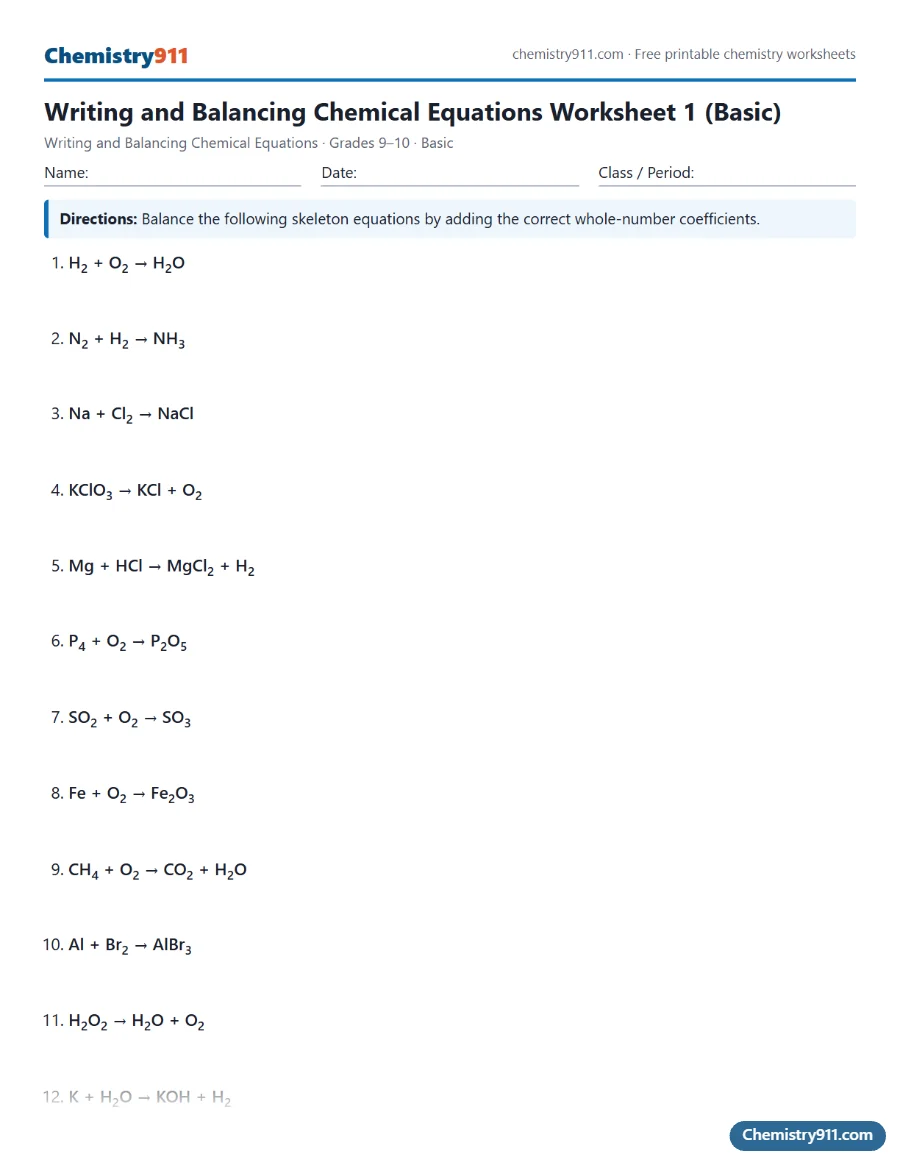
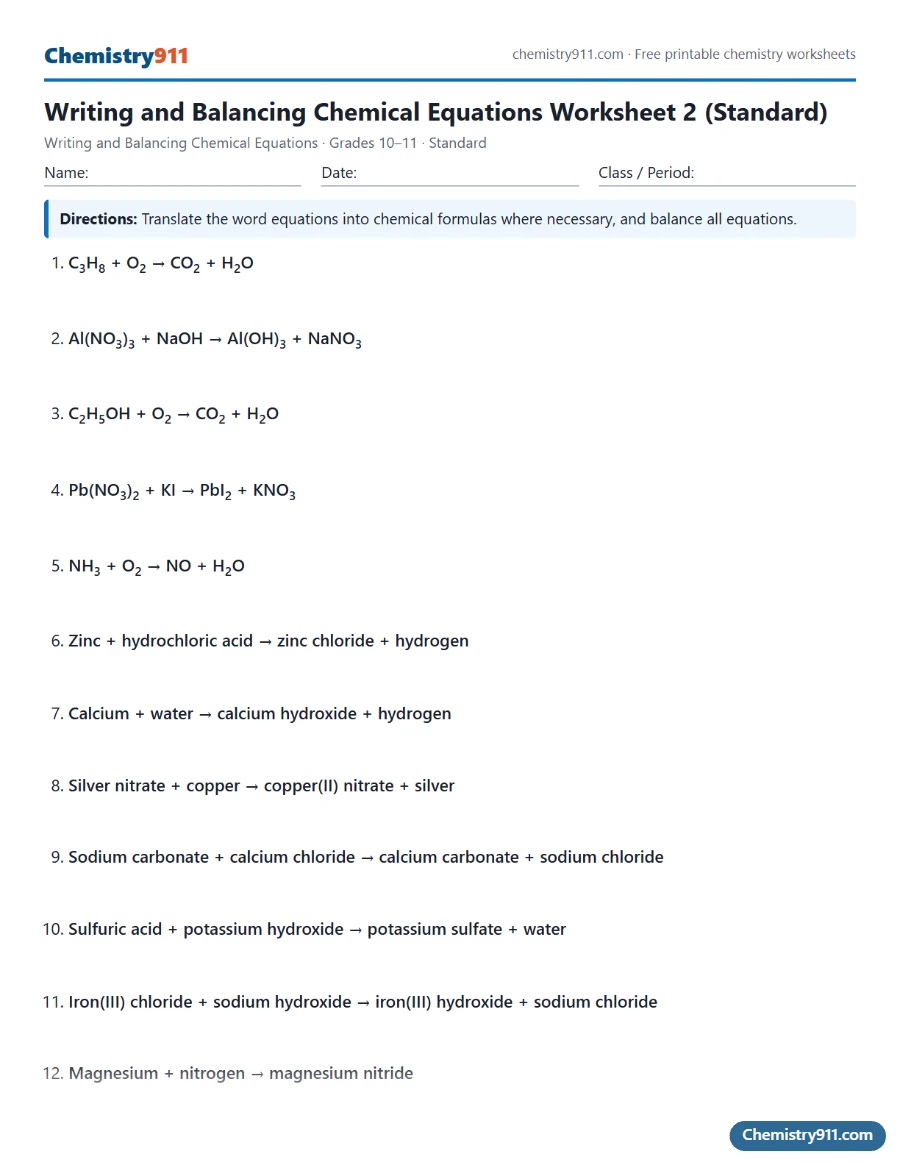
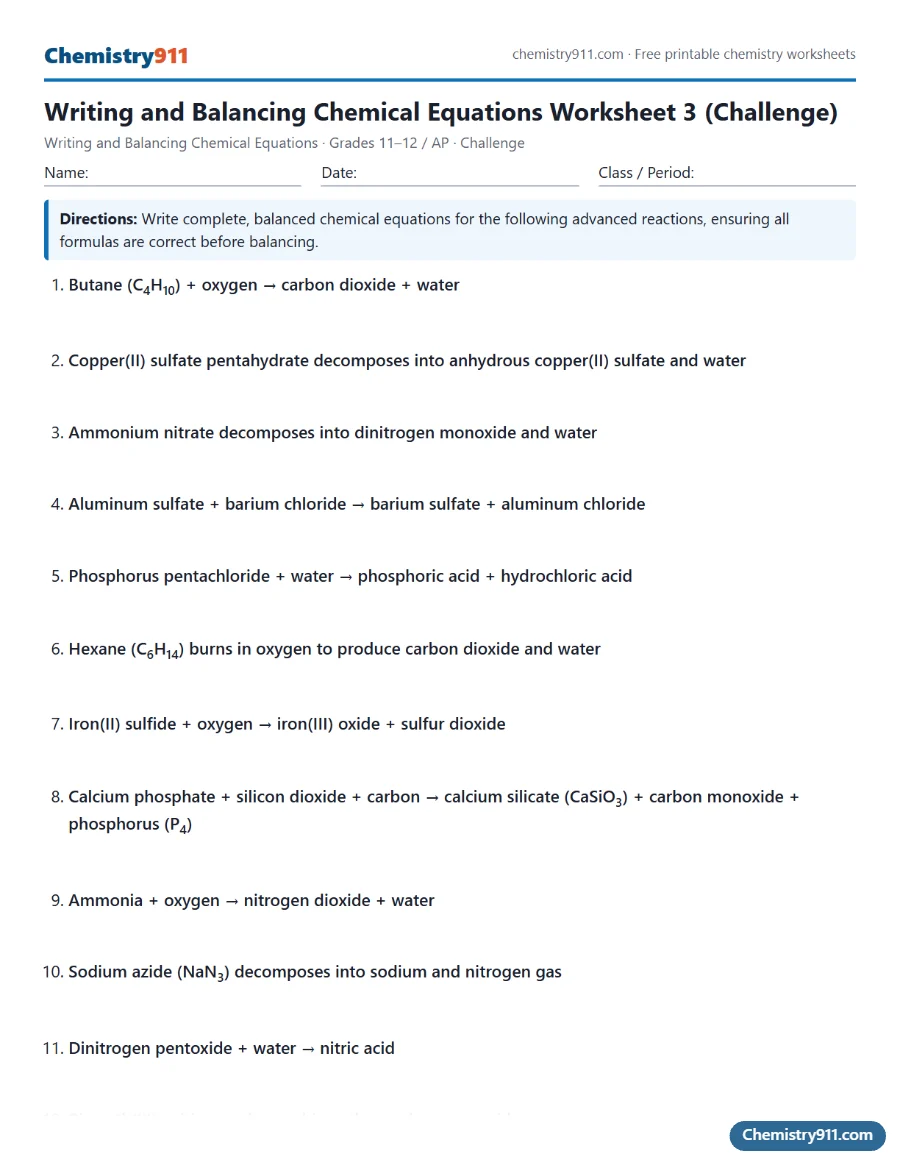
These worksheets help students practice translating word equations into chemical formulas and balancing the resulting equations. The set includes three printable PDFs—ranging from basic skeleton equations to advanced stoichiometry—each with a complete answer key.
Mastering chemical equations is a foundational skill in chemistry. Before you can calculate yields or analyze reaction stoichiometry, you must be able to write correct chemical formulas and balance the equation. These worksheets provide structured practice to build accuracy and confidence.
What to Know Before You Start
Before balancing chemical equations, you must be comfortable with chemical nomenclature and the Law of Conservation of Mass. This law dictates that atoms cannot be created or destroyed in a chemical reaction; therefore, the number of atoms of each element must be identical on both the reactant and product sides.
When translating word equations into skeleton equations, remember the seven diatomic elements. When these elements appear in their pure, uncombined state, they must be written with a subscript of 2:
Additionally, you must ensure that all ionic compounds are written with neutral overall charges before you begin balancing. Never adjust the subscripts of a correct chemical formula to balance an equation.
How to Balance Chemical Equations
Balancing equations is an iterative process. Follow these steps to systematically balance any standard reaction:
- Write the skeleton equation. Ensure all reactant and product formulas are correct.
- Count the atoms. Tally the number of atoms of each element on both sides of the yield arrow (→). If a polyatomic ion remains intact across the reaction, count it as a single unit.
- Add coefficients. Place whole numbers in front of formulas to balance the elements. A useful strategy is to balance metals first, then nonmetals, leaving hydrogen and oxygen for last.
- Reduce and verify. Check that your coefficients are in the lowest possible whole-number ratio, and recount all atoms to confirm balance.
Problem: Balance the reaction between solid iron(III) oxide and carbon monoxide gas to yield solid iron and carbon dioxide gas.
Step 1: Fe2O3 + CO → Fe + CO2
Step 2 & 3: Iron has 2 atoms on the left, so place a 2 before Fe on the right. Carbon is balanced (1 and 1). Oxygen has 4 on the left (3+1) and 2 on the right. By placing a 3 in front of CO and a 3 in front of CO2, carbon remains balanced at 3, and oxygen balances at 6 on both sides.
Step 4: The balanced equation is: Fe2O3 + 3 CO → 2 Fe + 3 CO2
Common Mistakes to Avoid
The most frequent error students make is altering subscripts to force an equation to balance. For instance, changing H2O to H2O2 balances oxygen, but it changes water into hydrogen peroxide, fundamentally altering the chemistry. Always use coefficients.
Another common pitfall is forgetting to distribute the coefficient to every element in a compound. A coefficient of 3 in front of Ca(NO3)2 means there are 3 calcium atoms, 6 nitrogen atoms, and 18 oxygen atoms. Finally, when dealing with combustion reactions of large hydrocarbons, students often get stuck with an odd number of oxygen atoms on the right. If this happens, double all other coefficients first; this will force the oxygen requirement to be an even number, allowing you to easily find the correct coefficient for O2.
How Teachers Can Use These Worksheets
This set of worksheets is designed to scaffold student learning from basic recognition to advanced stoichiometry preparation. The Basic worksheet provides pre-written skeleton equations, allowing students to focus purely on the mechanics of adding coefficients. It serves as an excellent warm-up or introductory homework assignment.
The Standard worksheet introduces word equations alongside more complex skeleton equations. This requires students to synthesize their knowledge of nomenclature and balancing, making it ideal for general chemistry classwork or quizzes. The Challenge worksheet features advanced reactions, including complex polyatomic breakdowns and challenging combustion reactions, providing rigorous practice for honors or AP Chemistry students.
Frequently Asked Questions
Why do we balance chemical equations?
We balance equations to satisfy the Law of Conservation of Mass, which states that matter cannot be created or destroyed. The number of atoms of each element must be identical on both the reactant and product sides.
Can I change the subscripts to balance an equation?
No. Changing a subscript alters the chemical identity of the substance. You may only change the coefficients, which are the numbers placed in front of the formulas.
What are the seven diatomic elements?
The seven elements that naturally exist as diatomic molecules are hydrogen (H2), nitrogen (N2), oxygen (O2), fluorine (F2), chlorine (Cl2), bromine (Br2), and iodine (I2).
How do I handle polyatomic ions when balancing?
If a polyatomic ion appears unchanged on both sides of the equation, treat it as a single unit rather than counting its individual atoms. This makes the balancing process much faster and less prone to errors.
What is a skeleton equation?
A skeleton equation shows the correct chemical formulas for the reactants and products but does not yet include the coefficients needed to balance the atoms.